
Are you unsure how to cite AI-generated content in your academic work? Firstly, you have to ensure that the information generated through AI is accurate. After that, you should cite the sources that were used to generate the AI outputs. When you cite AI in academic writing, you should follow your institution’s rules and the appropriate referencing manual.
Currently, Artificial Intelligence (AI) tools like ChatGPT, Google Gemini, and Microsoft Copilot have revolutionized the way students conduct their research, brainstorm, and write assignments. But when you use AI in academic writing, you should protect academic integrity by citing the content generated by AI writing tools. Usually, acknowledging AI-generated content will also enable you to remain transparent in your research process and show readers where your ideas came from. For citing AI-generated content, you should choose a referencing style based on your institution’s rules and the AI tool you used. If you are clueless about how to cite AI-generated content in your academic work, then read this guide. Here, we have explained the citation of AI-generated content using APA 7, MLA 9, Chicago, and Harvard styles with practical examples and simple steps to follow.
What is AI Citation and Why Is It Important?
AI content citation means giving credit to the generative AI tool when the content it generates adds value to your academic work. The content can be text, summaries, ideas, images, translations, or any other generated materials.
When compared to the citation of sources such as a book or journal article, an AI response might not always be accompanied by a definite author or a publication date. Depending on the referencing format you use, the AI citation will usually contain information such as the tool’s name, developer, model or version, date of generation, prompt description, and conversation URL.
Why should you cite AI-generated content?
Citing AI-generated content in your academic work will help you to achieve the following
- Promote academic integrity: It will be easy for the readers to understand which parts of the work were written with the help of an AI tool.
- Improve transparency: It will help instructors to distinguish between your personal analysis and the text created by an AI tool.
- Favor verification: The citation or disclosure will enable the readers to understand how the text was created.
- Prevent plagiarism issues: Appropriate acknowledgment will prevent the misrepresentation of the text created by an AI as your personal effort.
The referencing principle also extends to regular sources of information. If you want to know how citations support credible academic arguments, read our guide on the importance of referencing in academic writing.
Always remember that the citation of an AI tool doesn’t mean that you can use it without any limitations. Your teacher or university may prohibit the use of AI-generated text altogether or demand some kind of disclosure. So, before you use AI in academic writing, make sure to check your institution’s rules.
How to Cite AI-generated Content in Different Referencing Styles
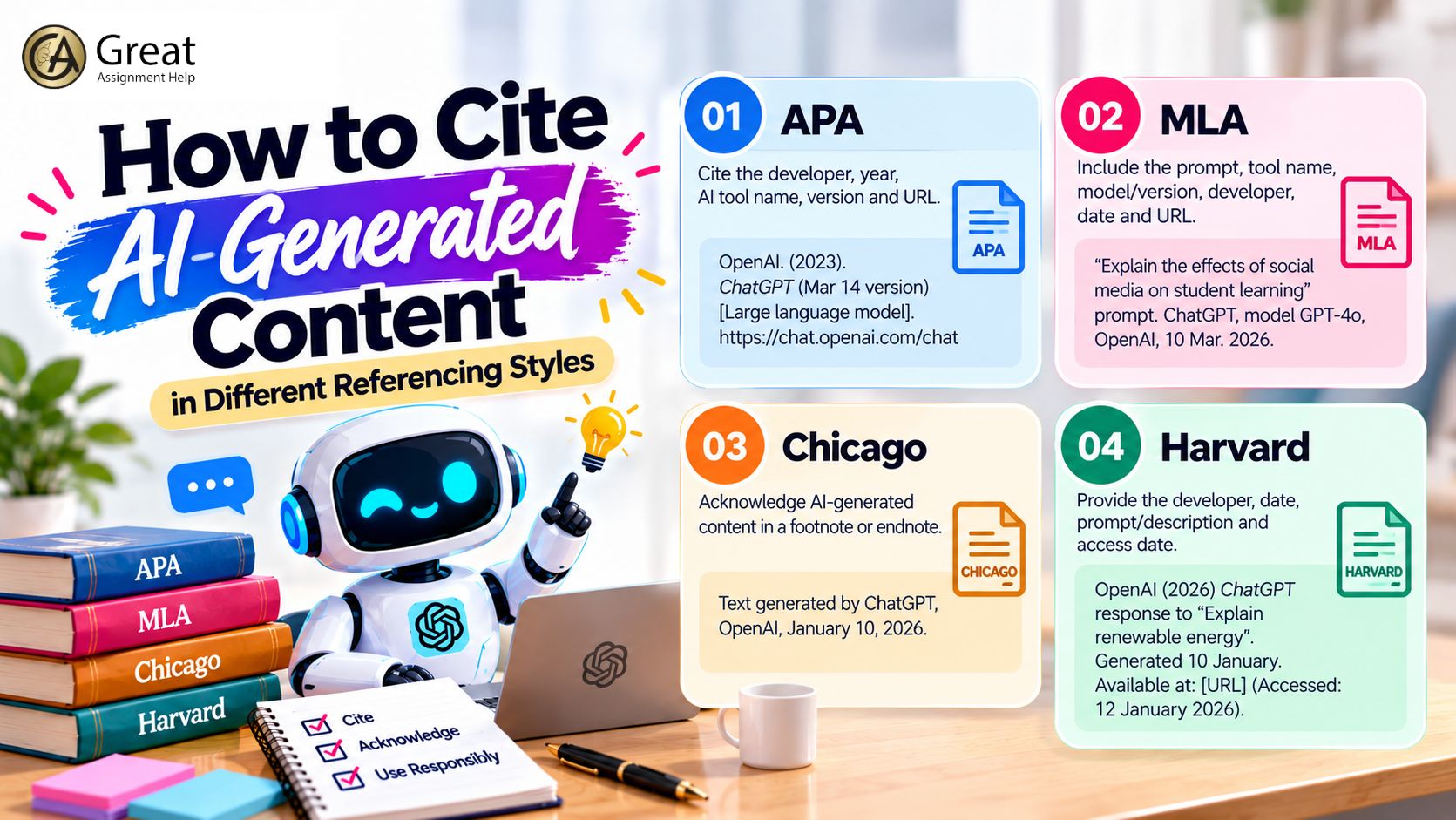
When you use AI-generated content in your assignments, you should cite it in line with the referencing style recommended by your educational institution. Every citation style has its own set of requirements. Some styles employ author-date citation while others depend on footnotes or a works cited page. Understanding these differences will help you acknowledge AI assistance correctly and maintain academic integrity.
Here is how to cite generative AI content in four common referencing formats.
APA 7 Citation Style
If you use the American Psychological Association (APA) 7th edition formatting style, then you have to cite the developer of the AI software as the author and the software as a large language model. Your citation should contain information on the creator, the publication year, the tool’s name, version, description, and web address.
Reference list format:
Developer. (Year). Name of AI tool (Version) [Large language model]. URL
Example:
OpenAI. (2023). ChatGPT (Mar 14 version) [Large language model]. https://chat.openai.com/chat
In-text citation: (OpenAI, 2023)
But this rule does not fit every citation from ChatGPT. If you want to cite the AI tool in your academic paper, then you need to provide additional information, namely the date of creation of the output, the model used, and the URL.
MLA 9 Citation Style
If you are following the rules of the MLA 9th edition citation style guide, then you need to describe the AI-generated text and specify the name of the AI tool along with its model/version, the developer name, the content generation date, and the URL address. Moreover, the new guidelines of the MLA, published in August 2025, suggest that you should mention a stable, shareable conversation link when available to make it easy for your readers to access the response you used.
Works Cited format:
“Description of prompt” prompt. AI Tool, model/version, Developer, Day Month Year, URL.
Example:
“Explain the effects of social media on student learning” prompt. ChatGPT, model GPT-4o, OpenAI, 10 Mar. 2026, [shareable conversation URL].
In-text citation: (“Explain the effects”)
In case you wish to create your own citation, then replace the details from this example with the information from your conversation. MLA doesn’t treat the AI tool as a conventional human author. If the AI tool provides references to books, articles, or other published sources, then verify those sources directly and cite them when they support your argument.
Chicago Citation Style
If you follow the Chicago style, then based on your assignment requirements, you can use either the notes-and-bibliography system or the author-date system. But when you refer to AI-generated content in your academic work, you should make sure to acknowledge the source in a footnote or endnote.
Footnote example:
- Text generated by ChatGPT, OpenAI, January 10, 2026, [shareable conversation URL].
In case you have failed to explain the prompt in the main text, remember to include it in the footnote instead.
- ChatGPT, response to “Explain the causes of the American Revolution,” OpenAI, January 10, 2026, [shareable conversation URL].
When you prepare an assignment that requires a bibliography, check whether your instructor expects you to include AI conversations in it. Chicago does not always treat these interactions like conventional published sources, so you should follow the relevant guidelines for your work. For further assistance, see our Chicago Manual 17 Citation Guide.
Harvard Referencing Style
For Harvard referencing, there is no single universal version of the style. The citation rules will differ from university to university for acknowledging AI-generated content. So, before you add your references, you need to consult your institution’s guidelines first and make sure to provide all the necessary information.
Reference list:
OpenAI (2026) ChatGPT response to “Explain renewable energy”. Generated 10 January. Available at: [shareable conversation URL] (Accessed: 12 January 2026).
In-text citation: (OpenAI, 2026)
You can use the following example as a basis; however, depending on your university requirements, you may need to provide additional information about how you applied AI, what kind of prompt you provided, or append the conversation. For more information, refer to our Harvard Referencing Guide.
What Details Should You Include When Citing AI?
Your citation needs to offer sufficient information so that your readers would be able to recognize the tool used and understand the output you cited. However, the exact citation requirements may differ based on the style you choose.
While citing AI tools in your academic paper, you should collect and include the following information:
- Name of the tool: ChatGPT, Gemini, Copilot, or any other AI tool.
- Creator: This is the organization responsible for the development of the tool.
- Model/Version: When available and necessary.
- Date: Indicate the date when you received the response.
- Description of Prompt/Output: Offer a sufficient description of the prompt/output for your readers to recognize it.
- URL: When offered by the tool and recommended by your citation style.
Another thing you have to decide is whether you need to cite the AI response itself or the sources behind its claims.
For example, if ChatGPT suggests a statistic related to the students’ learning process and supports this information with a scholarly article, open the scholarly article, find the statistics, and use the scientific journal article as the supporting source if it supports your claim. Do not support your statement with AI-generated evidence.
This is an important point to remember since AI-based tools can generate credible sources that are not real. As William H. Walters and Esther Isabelle Wilder note in their 2023 research article for Scientific Reports, out of 636 references generated by two versions of ChatGPT, there were numerous citations and fabrications. This is the reason why you should always verify the AI-generated sources.
Moreover, the MLA Style Center states that it is necessary to verify the sources suggested by AI before using summaries. If you wish to know more about citing AI tools, then refer to our guide on how to cite AI tools in academic papers.
A Simple Framework for Citing AI-generated Content
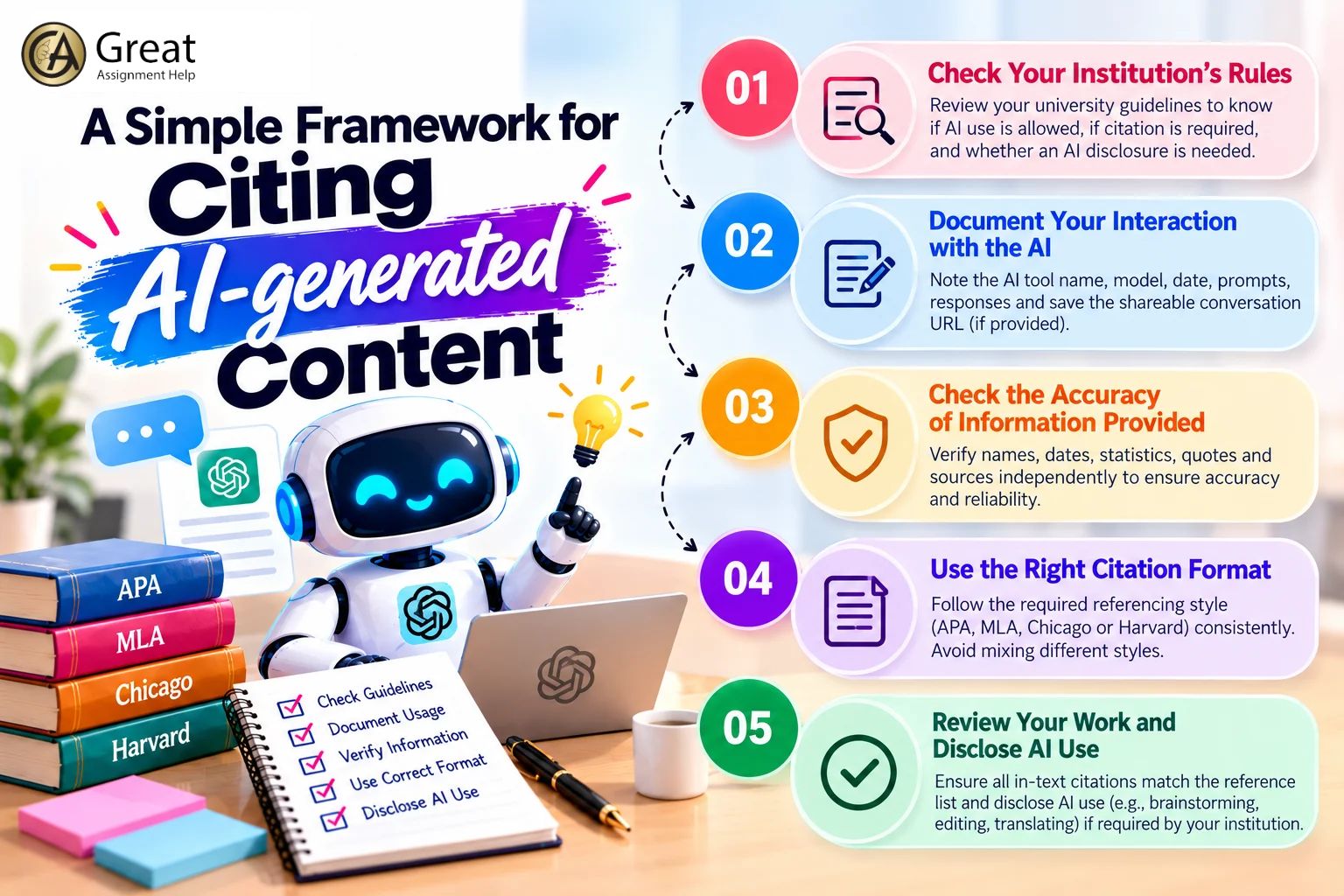
Whenever you use AI tools for your academic work, make sure to cite it by following your institution’s guidelines. Especially when it comes to citing your AI use, you should follow these five steps to maintain academic integrity
Step 1: Check Your Institution’s Rules
Before you use any AI-generated text directly in your assignment, make sure that you are familiar with your assignment guidelines and your university policies about AI. This will help you determine whether AI usage is allowed, citation is needed, and an AI disclosure is required.
Step 2: Document Your Interaction with the AI
Every time you interact with an AI system, note down the name of the AI system, the model used by the system, the date of interaction, the prompts you have used, and the answers based on which you have completed the task. Also keep a record of the shareable conversation URL, if provided. Save only what you need for your academic purposes; do not share any confidential or personal information with the AI.
Step 3: Check the Accuracy of Information Provided
Always check names, dates, statistics, quotes, and sources independently to ensure that the information provided by the AI tool is accurate. In this way, you can prevent yourself from using misleading and inaccurate data, thus making your academic work trustworthy and well-supported with relevant information.
Step 4: Use the Right Citation Format
Once you know which referencing style your institution requires, apply its rules consistently. No matter whether you use APA, MLA, Chicago, or Harvard referencing style, make sure your citations follow the appropriate format. Avoid mixing different styles.
Step 5: Review Your Work and Disclose AI Use
Check whether all in-text citations correspond to the correct reference list before submitting your assignment. Also, if you used AI for brainstorming, editing, translating, or outlining your work, disclose it in case it is required at your educational institution or publisher.
Citation and disclosure have their differences. While the former allows you to identify the AI-generated content, the latter tells about how AI was involved in the entire writing process.
According to Great Assignment Help’s guide on maintaining academic integrity, you also need to check your university’s regulations regarding the use of AI, as well as the authenticity of the AI-generated information. According to Dr. Jean Mathew, Senior Academic Writer at Great Assignment Help:
“AI will help to present the ideas in a complicated way; however, real paraphrasing requires a good understanding of the topic. Technical tools can only be considered assistants in studying, but never a substitute for the analytical skills which are the most useful at universities.”
Thus, you must consider the AI tool as something to facilitate the learning process, but not replace your skills with it.
Example: Citing an AI-generated Paragraph in an Assignment
Now assume you have been asked to write an assignment on renewable energy. While you write, you ask ChatGPT to list the advantages of solar energy and include the answer in the introduction.
Before including the explanation from ChatGPT, first make sure that using AI for this assignment is allowed by your instructor. Moreover, cross-check the facts related to the cost-effectiveness, efficiency, or greenhouse gas emissions of solar energy with reputable reports or scientific studies.
If you include the AI-generated explanation in your assignment, it is necessary to reference or acknowledge it as per the required style. In APA style, you can use an in-text citation that mentions the developer and year of generation, while in Chicago style, you can acknowledge the response using a footnote.
On the other hand, in case you employ AI tools like ChatGPT just to brainstorm or discover the research question and further analyze it on your own using academic literature, your lecturer may ask you to provide an AI tool disclosure instead of making separate citations for all ideas generated with the help of the software. So, always consult your institution’s policies.
In both cases, make sure you cite the original research that supports your factual claims. Do not trust any citations given to you by the AI because you never know whether they are real or made up. You need to confirm that the source does exist and backs up your data.
Conclusion
Learning how to cite AI-generated content is an important part of modern academic writing. Whether you choose APA 7, MLA 9, Chicago, or Harvard styles, the main aim will always be proper referencing, credible facts, and transparency.
Before you submit your assignment, you need to familiarize yourself with the AI policies at your college or university, ensure that each piece of information is verified, and use the required citation format. However, keep in mind that proper citation won’t legitimize any banned AI usage, nor will it substitute your critical thinking.
If you are still not sure about how to cite AI-generated content in your academic paper, refer to the resources available at Great Assignment Help or hire an assignment expert with a strong knowledge of referencing. Professional guidance will make it easy for you to develop accurate, transparent, and well-cited academic work.
FAQs
1. Do I need to cite ChatGPT in an academic paper?
Yes. If you use ChatGPT-generated text, ideas, or other content in your academic paper, then you should give credit to the tool as per your university’s guidelines. Also, you may need to disclose the use of AI for brainstorming, editing, or research.
2. How do I cite AI-generated content in APA 7 format?
When it comes to citing AI-generated text in APA 7 format, you should make sure to include the AI tool’s developer as the author, the year, the tool name, model information when available, and the URL.
3. Can I cite AI-generated content in MLA 9 style?
Yes. But when you need to cite using MLA style guidelines, you should describe the content created by the software, indicate what software was used, its version, developer name, and the year it was developed, and include a shareable URL, if any.
4. Is citing AI-generated content enough to avoid plagiarism?
No. Citation is just one aspect of responsible AI use. You have to abide by your institution’s guidelines, disclose AI assistance where required, check facts, and make sure that your submission matches the critical thinking level that your assignment demands.